

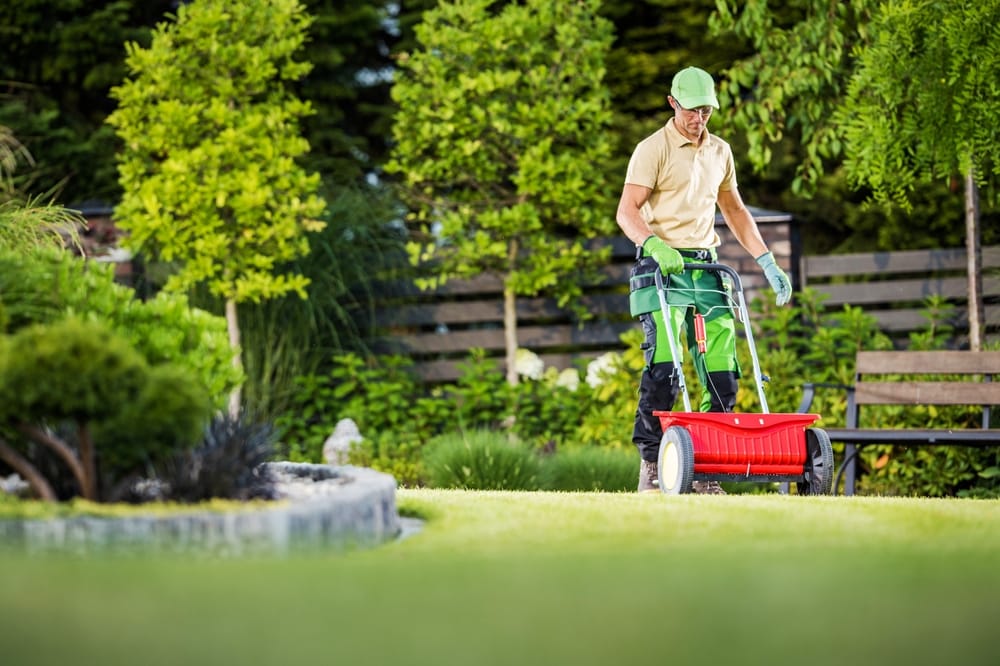
Your lawn needs to be fertilized to keep it healthy. A professional residential lawn fertilization service can help prevent common issues like discoloration, thinning grass and invasive weeds. Our team of knowledgeable experts will create a customized plan to provide your lawn with the right nutrients at the right time to support healthy, thriving grass.
We hope you are signed up for our fertilization and weed control program so your lawn gets everything it needs to stay healthy. And if you aren’t using our services, are you sure you’re fertilizing your lawn properly?
What You Need to Know About Decoding Fertilizer Labels
Every bag of fertilizer is labeled with three numbers. Those numbers represent the percentages by weight of three key nutrients plants need—nitrogen (N), phosphorus (P), potassium (K). For example, a fertilizer bag labeled 20-10-20 contains 20% nitrogen, 10% phosphorus and 20% potassium.
Lawns in North Texas need nitrogen for green, lush top growth, plus phosphorus and potassium for strong roots and disease resistance. So, there would be 20% N, 10% P and 20% K, plus 50% carrier material in this bag. Note that the carrier does not contain nutrients. If you bought two 50-pound bags, you would have 20 lbs of nitrogen, 10 lbs of phosphorus, 20 lbs of potassium and 50 lbs of carrier.
Quick-Release vs. Slow-Release Nitrogen Lawn Fertilizer
Nitrogen in lawn fertilizer comes in two forms, quick release or slow release. Slow-release fertilizers usually affect lawns for 3–10 weeks. Use slow-release nitrogen during the growing season for lawn fertilization to produce steady, constant growth.
Quick-release nitrogen fertilizers affect lawns for about 1–3 weeks. If someone treats your lawn with a liquid fertilizer, that is fast-release nitrogen. Slow-release fertilizer is granular and coated with sulfur or other products. As the outer coating dissolves, the fertilizer is released. With some forms of slow-release, the outer coating is designed to let the fertilizer pass through it little by little.
Some fertilizer bags just show the source of the nitrogen they contain. Others show the slow-release or quick-release forms they contain. A typical bag might show something like 21-0-0 urea nitrogen or 38-3-11 40% slow-release with 40% biosolids 10% Fe.
Organic lawn fertilizers are gaining popularity. Most of the nitrogen they contain is slow-release. Also, the amount of nitrogen these fertilizers contain is low compared to conventional lawn fertilizers. By weight, your lawn will require more organic fertilizer than conventional fertilizer. For example, a typical bag of organic fertilizer would be 5-3-2. A Bermuda or St. Augustine lawn needs about 4–5 pounds of actual nitrogen per year. That would mean applying about 100 pounds of organic fertilizer per year to meet the grass’s requirements.
How Much Nitrogen Fertilizer Does Your North Texas Lawn Need?
To calculate how much fertilizer to apply to your lawn, first determine its size. Fertilizer application rates are based on the area of your lawn in square feet. The area is determined by multiplying the length of your yard by the width.
Second, determine what type of grass you have. In North Texas you will likely have Bermuda or St. Augustine. There are also some Zoysia lawns and some Tall Fescue in shady areas. Assuming your lawn is St. Augustine or Bermuda, plan on 4–5 pounds of nitrogen, 1.5 pounds of phosphorus, and 2.5 pounds of potassium per year. Zoysia needs less nitrogen; plan on 3.5 pounds.
Determine how many pounds of fertilizer you must apply and divide it between treatments from around April 15th to August 15th. Be sure to calibrate your spreader to dispense the correct amount.
If you buy a slow-release fertilizer that will release over 5–6 weeks, you will need a total of at least 3 treatments.
Transform Your Landscape With Expert Lawn Fertilization Services
Want a lush, green lawn? With professional fertilization services from Green Top Lawn Care, your turf will thrive. Our lawn care experts will ensure your grass receives the right nutrients at the right time. Call (817) 684-4044 and request a free lawn fertilization quote today.


